
Undercut Depth Limits in Silicone Molds: When Soft Shore Still Tears
Undercut depth limits in silicone molds - how far Shore A 20-40 can stretch before tear, draft pairing, two-part splits, and RUUIPON specs at MOQ 50 with prototype 3-7 days.
 Kyler Yang · Founder5 min read
On this page
A 4 mm hook lip on a resin figurine cavity tears on pour 35 when your tray runs Shore A 35 with 2 mm webs - soft silicone does not forgive geometry that fights demold. RUUIPON builds custom silicone molds at MOQ 50 with prototypes in 3-7 days. This guide sets undercut depth limits by Shore A so your CAD survives vacuum-degassed pour and ~0.1% shrink without re-tooling.
Quick answer: On production trays with walls 2.5-5 mm and spacing 8-20 mm, plan undercut depth ≤1.5 mm per side on Shore A 30-40 resin molds, ≤2.5 mm on Shore A 20-25 food molds, and zero undercut on stiff Shore A 45+ unless you split the mold. Deeper hooks need two-part parting lines or collapsible cores - not "just use softer silicone."
Undercut Depth in One Table
Undercut depth is how far a cavity feature extends past the widest demold plane - measured perpendicular to pull direction, not along the sloped face.
| Shore A | Max undercut depth (single pull) | Typical application |
|---|---|---|
| 20-25 | 2-3 mm | Chocolate, gummy - warm demold |
| 25-30 | 1.5-2.5 mm | Soap, wax melt |
| 30-35 | 1-2 mm | General resin, candle |
| 35-40 | 0.8-1.5 mm | Stiff resin, sharp logos |
| 40-50 | 0-0.8 mm | High-detail chocolate logos only |
What Counts as an Undercut on a Silicone Mold
Any cavity surface that blocks straight-line removal of the cast part is an undercut. Silicone stretches - that is the advantage over rigid steel - but stretch has a limit before the mold web or cavity lip tears.
- External undercut - bulbous midsection on a pillar; peel sideways to release.
- Internal undercut - re-entrant corner, hook, or dovetail inside the cavity.
- Negative draft - wall angled inward >0° from vertical counts as progressive undercut over height.
- Parting-line undercut - feature crosses the split plane without relief. See draft angles guide.
Master model undercuts copy 1:1 into silicone. A CNC master with 3 mm hook becomes a 3 mm hook in every cavity - master materials do not reduce undercut risk.
Depth Limits by Shore A Hardness
Softer silicone elongates more before tear - but tear strength and wall thickness still cap depth. We vacuum degas every production pour; shrink ~0.1% slightly tightens fit on deep hooks after cure.
| Feature type | Shore A 25 | Shore A 35 | Shore A 45 |
|---|---|---|---|
| Smooth external bulb | 3 mm | 2 mm | 1 mm |
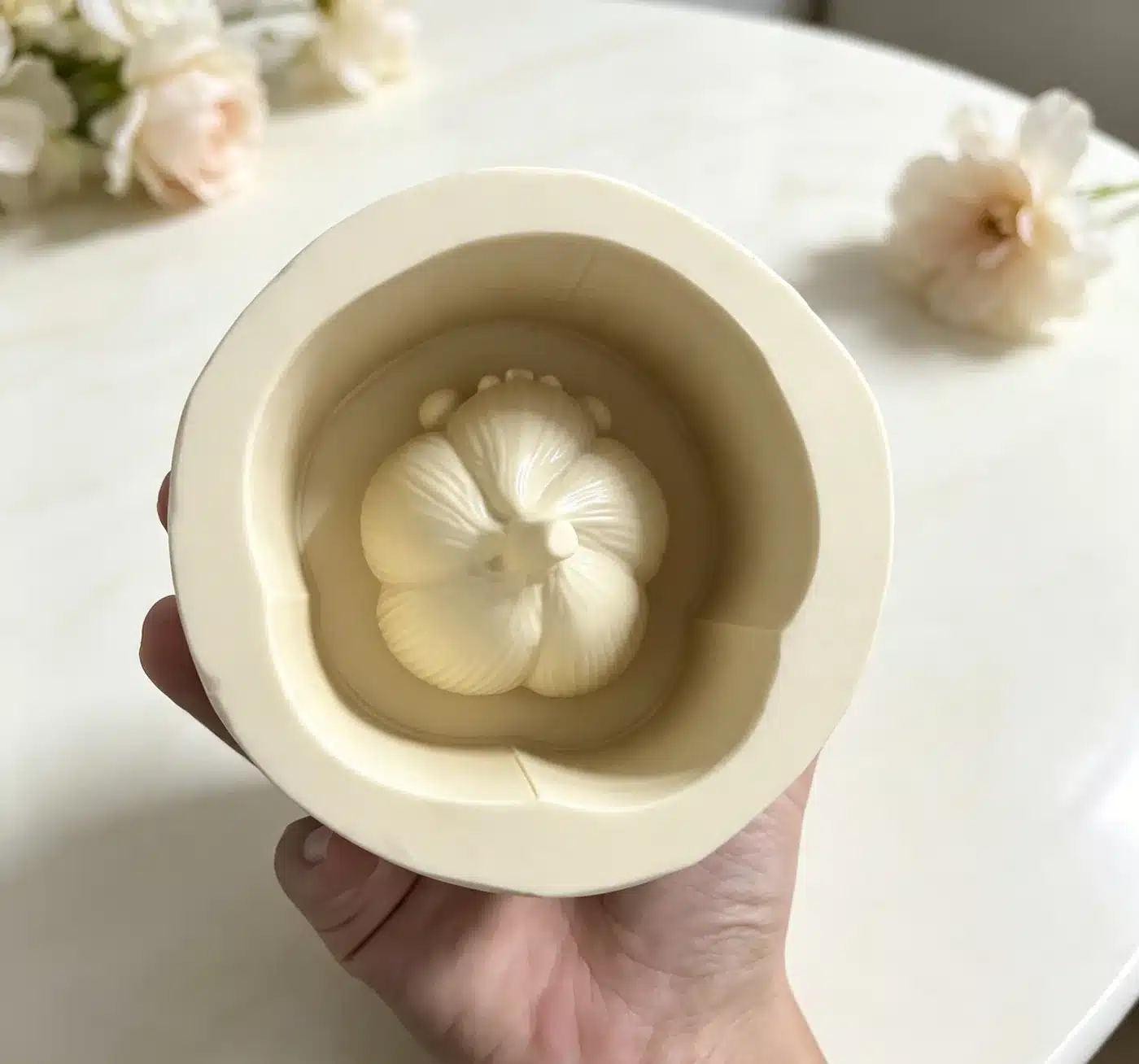
| Sharp internal hook | 2 mm | 1 mm | Split required |
| Embossed logo (0.5 mm line) | 0.4 mm depth OK | 0.4 mm depth OK | 0.3 mm max - logo limits |
| Thread or rib detail | 1.5 mm | 0.8 mm | Two-part only |
Full hardness selection: Shore hardness guide. Tear at demold: tear strength failures.
Draft Angle & Undercut Pairing
Draft reduces effective undercut over cavity height. Rule of thumb: 1° draft removes ~0.17 mm undercut per 10 mm of wall height.
| Cavity height | 1° draft relief | 3° draft relief | 5° draft relief |
|---|---|---|---|
| 20 mm tall | 0.35 mm | 1.0 mm | 1.7 mm |
| 40 mm tall | 0.70 mm | 2.1 mm | 3.5 mm |
| 60 mm tall | 1.0 mm | 3.1 mm | 5.2 mm |
Pair minimum 2° draft on resin cavities with undercut depth under 1.5 mm. Zero-draft vertical walls with hooks fail regardless of Shore A if webs are thin - walls stay 2.5-5 mm. Wall thickness.
When to Split: Two-Part Mold Lines
Undercut depth beyond single-pull limits needs a parting line through the feature - not thinner walls.
- Place split at widest section - each half pulls perpendicular to its face.
- Registration keys - 3-5 mm keys on flange; registration key spec.
- Flash control - clamp pressure on thin lips creates flash at split. Flash QC.
- Seam on candle/resin - hide on rear edge. Seam line placement.
Compare one-part vs two-part economics: one-part vs two-part.
Tear Failures We See at MOQ 50 QC
| Failure | Root cause | Fix before production |
|---|---|---|
| Web snap between cavities | Undercut + 2 mm web | Increase spacing to 12-20 mm; thicken web to 3 mm |
| Cavity lip rip | 3 mm hook, Shore A 40 | Split mold or reduce hook to 1 mm |
| Progressive tear after pour 50 | Stress at sharp undercut root | Radius ≥0.5 mm on hook root; soft Shore A 25-30 |
| Cast part stuck | Negative draft 2° over 30 mm height | Add 3-5° draft or two-part |
Layout density makes undercuts worse - cavity spacing 8-20 mm gives silicone room to flex during peel.
Production Spec at MOQ 50
| PO line | Example |
|---|---|
| Pull direction | Arrow on drawing - Z-axis demold |
| Max undercut per side | 1.5 mm @ Shore A 35 - or split noted |
| Draft minimum | 2° resin / 1° chocolate |
| Silicone | Platinum cure, vacuum degassed, ~0.1% shrink |
| Walls / spacing | 2.5-5 mm walls, 8-20 mm cavity spacing |
| Sample | 5 test demolds on prototype in 3-7 days |
Send STEP with pull direction and undercut callouts to [email protected] | Contact RUUIPON | WhatsApp +86 135 3006 2969.
Frequently Asked Questions
Can soft Shore A 20 fix a 5 mm undercut?
No - the cavity lip and webs still tear. Split the mold or reduce hook depth.
Do undercuts affect cycle life?
Yes - stress concentrates at hooks; expect 30-50% shorter life vs clean-draft cavities. Cycle life by application.
Will vacuum degassing help demold?
Degassing removes bubbles - it does not add stretch. Vacuum degassing guide.
Chocolate undercuts?
Warm demold allows ~2 mm on Shore A 20-25; deeper logos need tapered walls. Chocolate Shore A.
Can RUUIPON DFM my undercuts?
Yes - we flag red lines on quote. DFM red flags.
MOQ with complex undercuts?
Still MOQ 50; two-part molds may add 3-5 days to prototype lead time.
Prototype before MOQ?
Single-cavity sample in 3-7 days - test demold 10× before production approval.
Ready to order custom silicone molds?
Free quote for OEM/ODM projects. MOQ 20 · Prototype 3-7 days · FDA/LFGB available.