
Flood-and-Scrape Silicone Molds: What to Brief Before DFM
How flood-and-scrape trays differ from fill-per-cavity: flat scrape face, edge margin, and what to send on an RFQ. RUUIPON MOQ 50 — no depositor-brand fit claims.
 Kyler Yang · Founder5 min read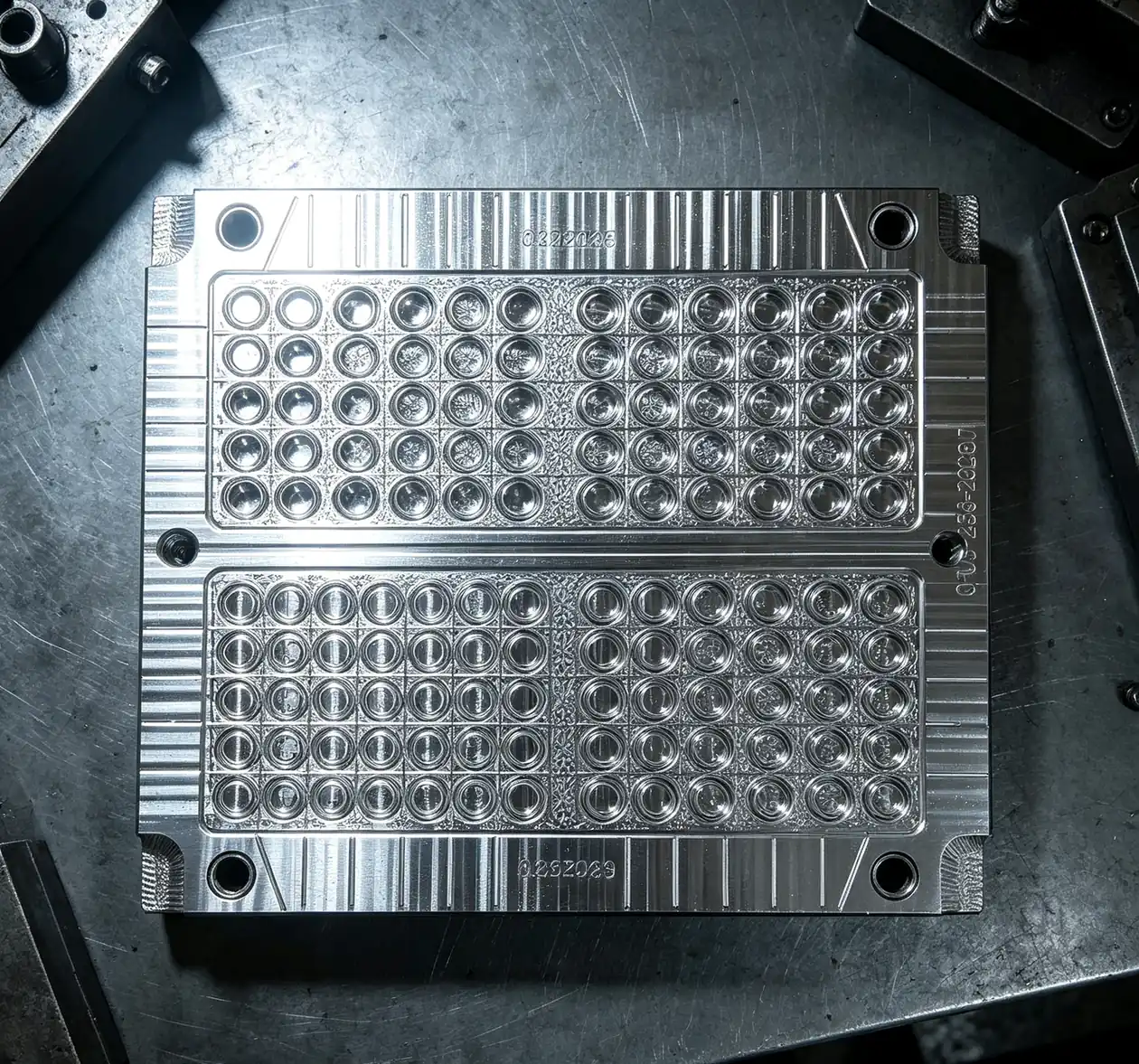
On this page
RUUIPON is a Shenzhen custom silicone mold shop since 2018. MOQ 50 per design. Complete RFQs typically get a quote within about 24 hours. Prototypes commonly take 3–7 business days after CAD lock. Food-contact material and test documentation may be available depending on the selected material and destination market. We do not claim an FDA-certified factory, invent cycle life, or sell mold-release chemicals.
What Is Flood and Scrape?
Flood and scrape is a high-efficiency depositing method used in commercial gummy, candy, and chocolate production. Instead of filling individual cavities one at a time, the entire mold tray is "flooded" with product material, and a scraper blade passes across the surface to remove excess and level all cavities simultaneously.
This method offers significant advantages over single-cavity deposition:
- Speed: fill many cavities in one scrape pass (count set after DFM)
- Consistency: All cavities fill at the same time, reducing weight variation
- Efficiency: Minimal operator involvement, ideal for automated production lines
- Waste reduction: Excess material can be collected and reused
However, flood and scrape places unique demands on mold design that single-cavity methods do not. This guide explains the engineering considerations for flood-and-scrape compatible silicone molds.
Key Design Requirements
1. Surface Flatness
The top surface of the mold tray must be as flat as DFM can hold for your scrape method. This is critical because:
- The scraper blade rides on this surface to level product across all cavities
- Any warp, bow, or unevenness causes inconsistent product weight
- Surface irregularities create material waste and production delays
Specification: Surface flatness tolerance of ≤0.5mm across the entire tray surface.
2. Cavity Depth Consistency
Every cavity in the tray must have identical depth. Variation in cavity depth directly translates to variation in product weight:
| Cavity Depth Variation | Expected Weight Variation |
|---|---|
| tolerance confirmed after DFM | confirmed after sample pour (acceptable for most applications) |
| ±0.10mm | ±4% (may exceed tolerance for regulated products) |
| ±0.20mm | ±8% (unacceptable for dosed products) |
Specification: Cavity depth tolerance of tolerance confirmed after DFM across all cavities.
3. Structural Rigidity
During the scraping phase, the blade applies downward pressure across the entire tray surface. The tray must resist flexing under this pressure:
- Insufficient rigidity: Tray flexes, causing uneven scraping and variable cavity fill
- Adequate rigidity: Tray remains flat, scraper makes consistent contact, all cavities fill uniformly
Design features for rigidity:
- Structural ribbing between cavity rows
- Reinforced border frames (minimum 25mm width)
- Strategic rib placement that doesn't interfere with depositor nozzles
- Optimal tray thickness (typically 15-25mm depending on tray size)
4. Nozzle Clearance
The cavity layout must provide adequate clearance for your depositor's nozzle array:
- Minimum clearance: 10mm between cavity edge and tray edge
- Nozzle spacing: Layout must match your depositor's nozzle row and column spacing
- Scraper path: No cavities should be positioned where the scraper blade would cause obstruction
5. Pour Gate Design
For optimal fill performance, pour gates should be designed to:
- Distribute material evenly across all cavities
- Minimize air entrapment
- Allow excess material to flow to overflow channels
- Be positioned for easy access by the depositor nozzles
Depositor notes (confirm on RFQ)
We do not publish a compatibility list for named depositor brands. Send tray OD, scrape direction, and nozzle pitch if you have them. DFM will say whether a soft silicone tray can follow that path. Plant-scale depositor/mogul steel is not RUUIPON’s hero lane.
Mold Architecture for Flood and Scrape
One-Piece (Open) Molds — Recommended
For flood-and-scrape applications, one-piece (open) molds are the usual starting point because:
- Cavities are open to the top, allowing a scrape pass
- No parting line to interrupt scraper contact
- Cavity count is set after DFM — not a catalog maximum
Two-Piece (Split) Molds — Special Cases
Two-piece molds can be used when undercuts or 3D detail need a split. Parting flush and registration are confirmed in CAD — not assumed.
Tray Layout Optimization
Tray OD follows your packing or scrape fixture if you already have one. We do not sell a 40×60 / 50×70 catalog as “standard production sizes.” Cavity count follows piece weight, edge margin, and scrape path — see multi-cavity silicone molds and gummy cavity count.
Maintenance and Care for Flood-and-Scrape Molds
Daily Maintenance
- Inspect scraper contact surfaces for wear or damage
- Check cavity edges for tearing or deformation
- Clean excess material from tray surface immediately after production
Weekly Maintenance
- Deep clean cavities with food-safe detergent
- Inspect registration pins (for two-piece molds) for wear
- Verify surface flatness with a straight edge
Monthly Maintenance
- Measure cavity depth consistency across the tray
- Check for cumulative wear patterns
- Plan proactive replacement before production issues arise
FAQ
Q: Can I use my existing molds with a new depositor? A: Possibly, but we recommend verifying compatibility. Depositor nozzle patterns, scraper width, and tray dimension requirements vary by brand and model.
Q: How do I know if my current molds are suitable for flood and scrape? A: Check if your molds have a flat top surface, consistent cavity depth, and adequate structural rigidity. If you're experiencing weight variation or scraper issues, your molds may need redesign.
Q: What tray size do I need for my depositor? A: This depends on your depositor's specifications. Contact us with your depositor brand, model, and nozzle pattern, and we'll recommend the optimal tray configuration.
Q: Can flood-and-scrape molds be used for hand pouring? A: Yes. While designed for automatic deposition, flood-and-scrape molds work equally well for manual filling. The open cavity design allows easy manual pouring.
Published: 2026-08-12 | Category: Production Engineering | Read Time: 10 minutes
Ready to quote: send the brief to custom silicone mold quote or WhatsApp. Process path: manufacturing.
Ready to order custom silicone molds?
Free quote for OEM/ODM projects. MOQ 20 · Prototype 3-7 days · FDA/LFGB available.