
Custom Logo Silicone Molds: Minimum Line Width & Detail Limits That Cast Clean
Minimum line width and logo detail limits for custom silicone molds - emboss depth, draft, Shore A, and prototype workflow so branded cavities cast clean from MOQ 50.
 Kyler Yang · Founder5 min read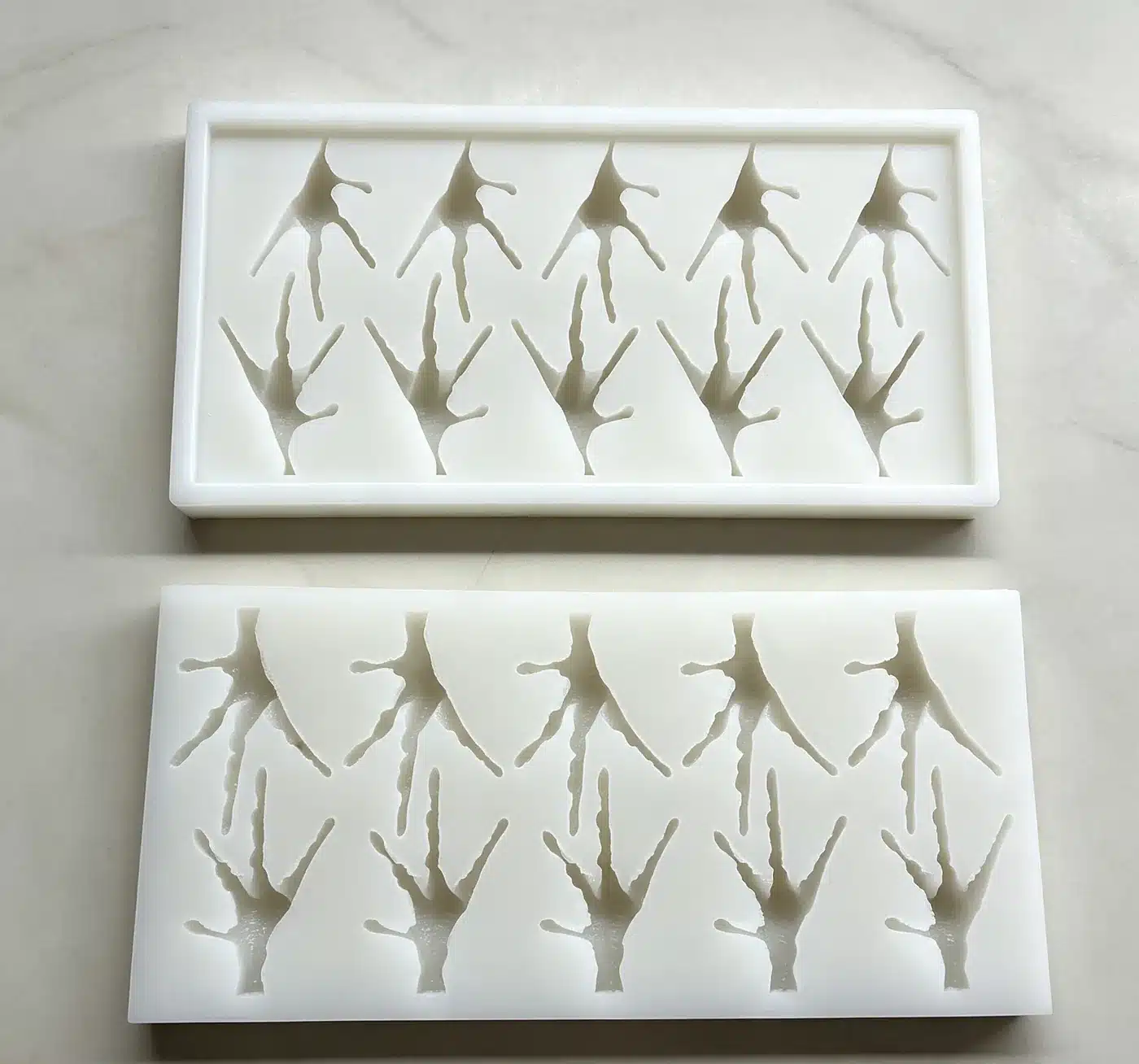
On this page
Your logo on a custom silicone chocolate mold only works if line width, emboss depth, and draft survive molding and casting. RUUIPON manufactures branded silicone cavities from MOQ 50 with prototypes in 3-7 days. This guide states detail limits in millimeters - not "high resolution" marketing language.
Quick answer: Plan raised logo strokes at least 0.6-0.8 mm wide for chocolate and resin; 0.8-1.0 mm for gummy and soap with soft demold. Keep emboss depth 0.3-0.6 mm on food faces unless you accept air traps and incomplete fill on every cycle.
What "Casts Clean" Means in Production
A logo casts clean when 95%+ of cavities show full stroke fill on the first pour without manual touch-up - across a full tray, not just the corner you photograph for Amazon.
Silicone captures finer detail than many casts can reproduce. The limit is usually the cast material (viscosity, surface tension, shrink) and demold, not the mold rubber's theoretical resolution.
| Logo feature | Typical minimum | Notes |
|---|---|---|
| Raised stroke width | 0.6 mm (resin/chocolate), 0.8 mm (gummy/soap) | Thinner strokes round off in silicone and clog in cast |
| Emboss depth | 0.3-0.6 mm food; up to 1.0 mm resin | Deeper = air lock on horizontal pours |
| Internal corner radius | R0.3 mm minimum | Sharp V-grooves tear and trap bubbles |
| Text height | 1.5 mm+ for 6 pt equivalent | Scale logo with cavity size, not screen pixels |
| Reverse (deboss) logo | +0.2 mm vs raised minimum width | Cast shrink ~0.1% silicone; resin/epoxy shrink separate |
Minimum Line Width Rules That Hold Up in Silicone
Vector art at 0.25 mm hairlines prints on paper; it does not survive platinum silicone tooling and repeated flex demold.
- Merge fine hatches - cross-hatching below 0.5 mm fills in during master finishing.
- Avoid parallel strokes <0.8 mm apart - merged into one blob in negative polish.
- Bold wordmarks for small cavities - a 25 mm chocolate square needs a simplified mark, not a 12-color crest.
- Test negative space - islands inside letters (O, A, B) need connecting bridges or minimum island width 0.8 mm.
OEM programs: private-label silicone molds and manufacturer brief.
Emboss Depth, Draft & Air Traps
Logo pockets need draft like any cavity wall - 1-3° on vertical logo sidewalls. Horizontal logo floors on a chocolate bar need vent paths or shallower depth.
- 0.3 mm depth - subtle shine difference on tempered chocolate; reliable fill.
- 0.5 mm depth - visible brand read at arm's length; still manageable on most bars.
- 0.8 mm+ depth - risk incomplete fill unless vacuum assist or thinner fluid cast.
Draft and undercut rules: undercuts & draft angles. Multi-logo trays: cavity layout with 8-20 mm spacing and 2.5-5 mm walls.
Detail Limits by Cast Material
| Material | Logo approach | Common failure |
|---|---|---|
| Tempered chocolate | 0.3-0.5 mm raised; polished floor | Chalky logo from over-deep pocket |
| Epoxy / polyurethane resin | 0.5-1.0 mm; thin strokes OK with low viscosity | Bubbles in sharp corners - degas cast |
| Gelatin / pectin gummy | 0.3-0.4 mm; wide strokes | Logo fills with starch; washout on demold |
| CP soap | 0.5-0.8 mm deboss common | Soda ash highlights rough micro-texture |
| Wax / soy melts | 0.4-0.6 mm | Shrink pulls fine detail off on cooling |
Material guides: chocolate manufacturing, resin design tips, gummy design guide.
CAD & Art File Prep
Send STEP/STL with logo modeled as solid geometry, not a screenshot traced at arbitrary scale.
- State finished part size - logo scales with cavity, not artboard.
- Specify raised vs deboss - raised logo on chocolate is usually cast-side deboss in the mold.
- Include parting line - logo placement relative to open face and split line.
- Note target Shore A - softer trays pick up micro-detail but wear faster. Shore guide.
- Mark food grade market - FDA/LFGB path for retail. FDA vs LFGB.
Prototype Proof Cycle (3-7 Days)
Never skip logo proof on a 1-4 cavity sample before MOQ 50 production.
| Stage | What you verify |
|---|---|
| Silicone prototype | Stroke sharpness, no torn micro-ridges at demold from master |
| First cast | Fill completeness, bubble map on logo corners |
| 10-cavity mini run | Consistency across tray; not just one hero cell |
| Sign-off | Photo + weight + logo rubric archived with PO |
Workflow: prototype to production. Vacuum degassing on mold pour reduces pinholes that mimic "blurry logo." Degassing guide.
Production Spec at MOQ 50
After logo approval, production trays use the same platinum batch discipline: mix by weight, degas, cure, flash trim, cavity ID marking. Silicone tooling shrink is roughly 0.1% - CAD accounts for it on critical logo width, not your cast material shrink (which varies by resin or chocolate line).
Quote ~24 hours with art + application. Contact RUUIPON - [email protected] | WhatsApp +86 135 3006 2969. Order path: how to order.
Frequently Asked Questions
Can you mold a QR-code-level fine detail?
Silicone can, but chocolate and gummy rarely fill it reliably. Simplify for production or use label/pad print for micro codes.
What file format is best?
STEP or STL with solid logo geometry; include PDF reference for human QC.
Does deeper logo mean stronger brand?
Often the opposite - shallow polished emboss reads cleaner on chocolate than deep sharp pockets.
MOQ with custom logo?
MOQ 50 production molds per approved design; logo prototypes quoted separately.
Prototype timeline?
3-7 days after CAD approval for logo sample cavities.
Can logo depth change on reorder?
Any geometry change needs new prototype - reference original PO and revision letter.
Etsy / small brand logos?
See Etsy sellers guide for launch sizing.
Ready to order custom silicone molds?
Free quote for OEM/ODM projects. MOQ 20 · Prototype 3-7 days · FDA/LFGB available.