
Two-Part Silicone Mold Registration Keys: Alignment That Prevents Flash
Two-part silicone mold registration keys - key geometry, depth, spacing, flash prevention, Shore A pairing, and how RUUIPON specs alignment at MOQ 50.
 Kyler Yang · Founder5 min read
On this page
Two-part silicone molds live or die on registration keys - misaligned halves flash at the parting line and ruin every cast until you re-tool. RUUIPON builds custom silicone molds at MOQ 50 with prototypes in 3-7 days. This guide covers key geometry, parting-line placement, and what to specify so your halves lock the same way on pour 1 and pour 500.
Quick answer: Registration keys are matching male/female bumps and recesses molded into the flange where the two halves meet. Depth 3-6 mm, diameter 6-12 mm, count 4-8 per mold set - enough to resist shear when you clamp but not so deep they thin the wall below 2.5 mm. Vacuum-degassed platinum silicone (~0.1% shrink) copies master keys within ~0.1 mm if the master was aligned during pour.
What Registration Keys Do on a Two-Part Mold
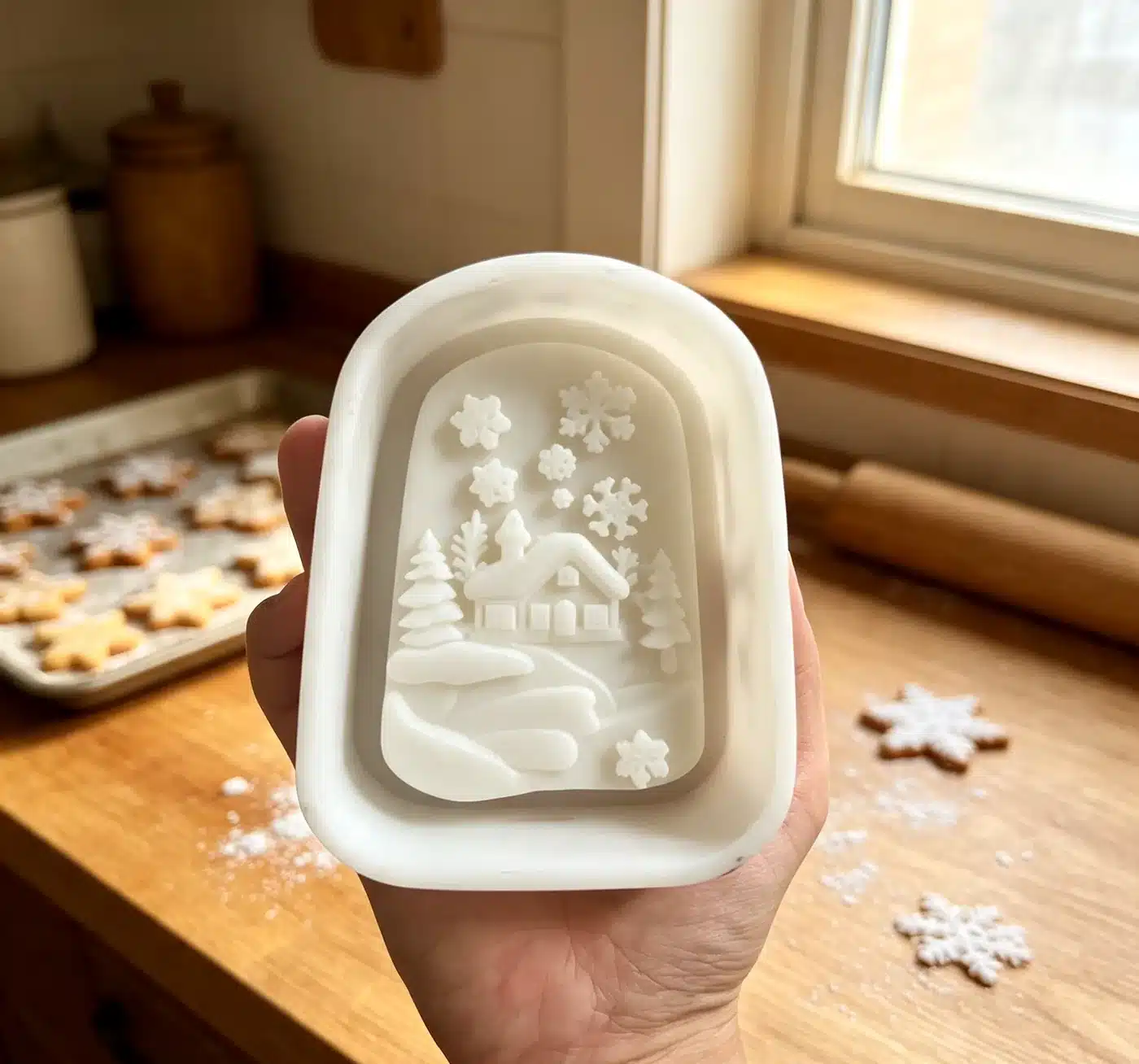
Keys keep the cavity half and cover half in the same XY position every cycle. Without them, silicone flex lets the top half slide 0.5-2 mm - enough for resin flash, chocolate fin lines, or soap seams you cannot trim cleanly.
| Key element | Typical spec | Why it matters |
|---|---|---|
| Count | 4-8 per set | 3 keys allow rocking; 6+ resists twist on large trays |
| Depth | 3-6 mm | Shallow keys slip; deep keys thin flange |
| Diameter / width | 6-12 mm round or 8×12 mm oval | Must survive demold without tearing |
| Clearance | 0.1-0.3 mm per side | Silicone shrink ~0.1% - tight keys bind |
| Placement | Symmetric on flange | Asymmetric keys feel "right" one way only |
Why Registration Keys Matter More Than Clamps
Hand pressure and rubber bands help on small molds; production trays at 8-24 cavities need mechanical repeatability. Keys do what your operator cannot hold steady for 200 demolds per shift.
- Flash at parting line - 0.3 mm misalignment on a resin mold leaves a fin you sand off every piece. Flash trimming QC.
- Cavity offset - logo half and base half mis-register; embossed text looks double-struck.
- Pour leakage - gap at spout root when halves shift; chocolate or wax leaks before set.
- Tooling cost - fixing keys after MOQ 50 production means new master half - not a trim pass.
One-part vs two-part decision: two-part vs one-part production molds. Undercuts that force two-part: undercuts and draft.
Key Geometry, Depth & Shore A Pairing
Round peg-and-hole keys are standard on food and resin trays. Dovetail or tapered keys resist pull-apart on deep molds but complicate master build.
| Shore A | Key style | Notes |
|---|---|---|
| 20-30 | Wide shallow keys (8-12 mm dia, 3-4 mm deep) | Soft flange deforms - avoid knife-edge keys |
| 30-40 | Standard round 6-10 mm, 4-5 mm deep | Most multi-cavity production trays |
| 40-50 | Can use slightly deeper keys | Stiffer - watch flange crack at sharp corners |
Wall thickness between key pocket and cavity floor must stay ≥2.5 mm - preferably 3-5 mm on production sheets. Cavity spacing 8-20 mm is independent of key placement; keys live on the outer rim.
Master build: keys are cut or modeled into the clay dam or CNC master before first silicone pour. Second half copies negative keys from the first cured half - release agent on keys is mandatory or the halves fuse. Vacuum degassing 2-5 minutes on each pour prevents voids in key faces. Vacuum degassing guide.
Parting Line Placement & Key Location
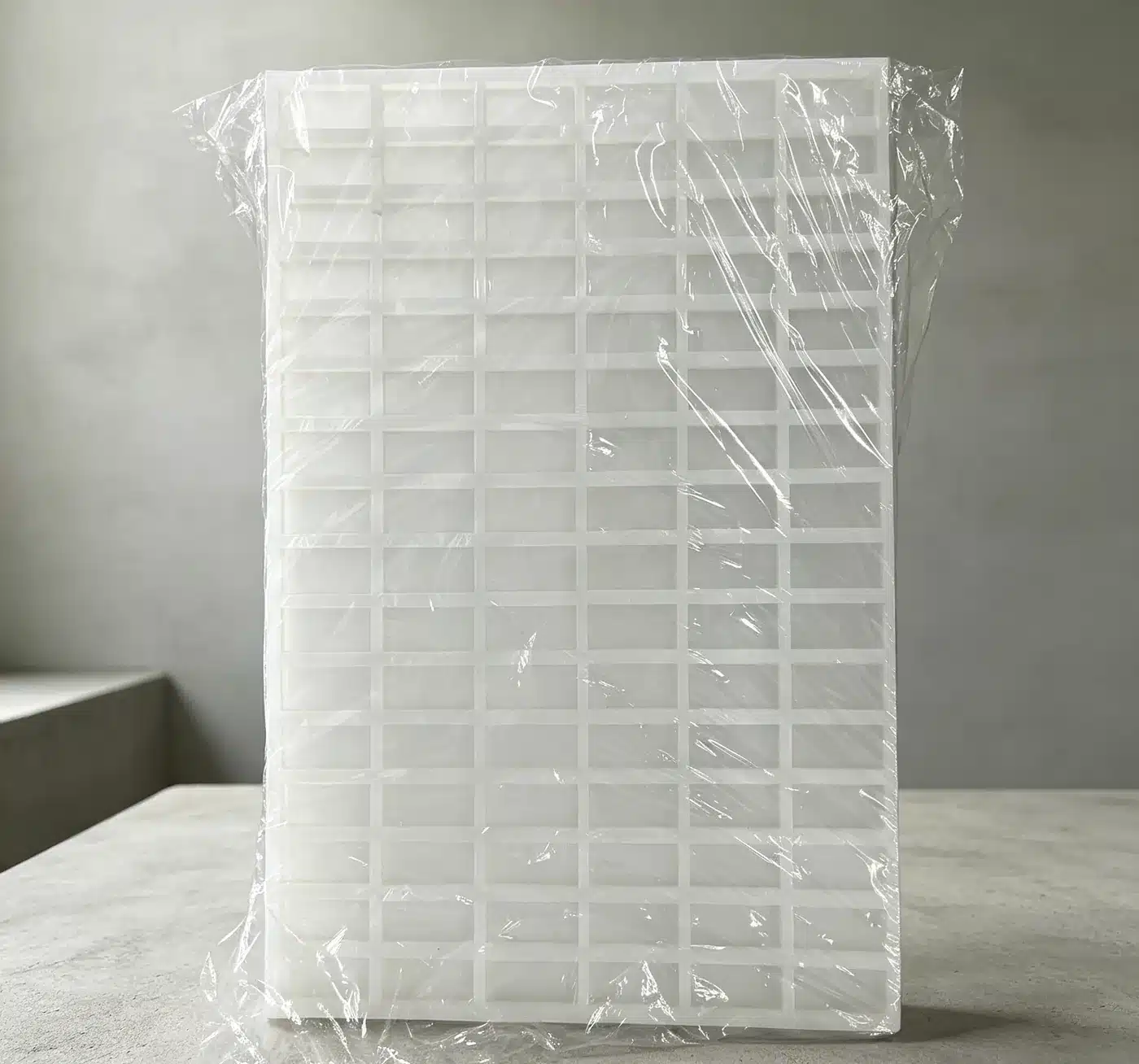
Keys belong on the flattest flange plane - not across undercuts or curved logo surfaces.
- Split at widest cross-section - minimizes trapped air and hidden flash pockets.
- Keep keys off pour spout path - spout and vent geometry: pour spout & vent design.
- Mirror symmetry - keys at corners + mid-span on long trays resist bowing.
- Mark orientation - arrow or asymmetric key count so operators do not reverse halves.
Prototype validates closure in 3-7 days. Run 5 test casts before signing sample - shift shows up as repeating seam line. Sample approval checklist.
Flash Prevention Beyond Keys
Keys fix alignment; these specs fix how much flash forms when halves meet:
| Factor | Spec |
|---|---|
| Parting line compression | Silicone flange 1-2 mm wide minimum - thin lip extrudes flash |
| Clamp method | Even pressure on flange, not cavity center |
| Material viscosity | Thin resin or hot chocolate finds gaps keys cannot close |
| Key wear | After ~500-2000 cycles, re-inspect key fit - lifespan & care |
Post-trim flash budget: flash trimming QC. Tolerance stack: shrinkage ~0.1%.
Production Spec at MOQ 50
| PO line | Example |
|---|---|
| Mold type | Two-part, platinum cure, vacuum degassed |
| Registration | 6× round keys 8 mm dia × 5 mm deep, 0.2 mm clearance |
| Shore A | 30-35 (resin) / 20-30 (chocolate) - Shore guide |
| Layout | Cavity spacing 8-20 mm, walls 2.5-5 mm |
| QC | Halves close flush; no >0.2 mm step at parting line on sample cast |
Production ~2-4 weeks after sample approval. Quote ~24 hours with CAD + parting-line sketch. [email protected] | Contact RUUIPON | WhatsApp +86 135 3006 2969.
Common Registration Key Mistakes
- Keys inside cavity footprint - creates flash dam and cleaning nightmare.
- Too few keys on large trays - 12-cavity sheet needs 6+ keys or corners lift.
- Identical shallow dimples - operator can rotate 180° and still "close" - use asymmetric layout.
- Skipping release on first half - keys tear out on second pour; half is scrap.
- No prototype closure test - MOQ 50 with misaligned keys is 50 trays of rework risk.
Brief your parting line on quote: manufacturer brief. Process: prototype to production.
Frequently Asked Questions
How many registration keys does a two-part mold need?
Minimum 4 on trays wider than 80 mm; 6-8 on multi-cavity production sheets. Small single-cavity figurines can use 3 if flange is stiff (Shore A 35+).
Can keys be added after the first sample?
Yes - counts as a revision; new master work 3-7 days. Revision process.
Do keys affect food safety?
No - same platinum cure and FDA/LFGB grade as the tray. FDA vs LFGB.
Round vs square keys?
Round is easier to demold and less stress-concentrating on soft Shore A 20-25 flanges.
What is MOQ for two-part molds?
MOQ 50 per approved CAD and sample.
Will keys wear out?
Slow deformation over hundreds of cycles - store flat, no weight on stacked halves. Storage & warping.
Can one-part molds have keys?
Uncommon - one-part uses open pour. Two-part is where keys are required. One-part vs two-part.
Ready to order custom silicone molds?
Free quote for OEM/ODM projects. MOQ 20 · Prototype 3-7 days · FDA/LFGB available.